
The Workforce Report:
Bridging the Mental Healthcare Gap

A new report released by Inseparable offers policymakers practical tools to build and sustain a stronger mental health workforce. It includes actionable state-level strategies to expand capacity, strengthen the pipeline of new providers, support those already delivering care, and leverage data and technology to improve access and outcomes so people can get the care they need, when they need it.
The Workforce Report Cover

The Workforce Shortage: A Problem We Can Solve

Too many Americans cannot access the mental healthcare they need, due in large part to a system that lacks enough providers and oftentimes the right kinds of providers to offer the appropriate services.

With 144 million Americans living in mental health shortage areas, no state comes close to meeting demand. The highest-performing state, Rhode Island, meets just over 58 percent of its need for mental health services. In nearly half of states, at least three-quarters of required workforce capacity is simply missing.

These shortages are not inevitable. They are the result of misaligned policies, burdensome requirements, and insurance practices that make it difficult for providers to enter or remain in the field. But with the right policies, there is hope – and a clear path forward.

Why Shortages Persist

Several interconnected forces drive workforce shortages:

  • Underinvestment in the workforce pipeline. High education costs, unpaid clinical hours, and complex licensure processes deter prospective providers — particularly those from rural areas and underrepresented communities — before they ever enter the field.
  • Low reimbursement. Mental health providers are routinely paid less than their medical counterparts for comparable services. In 18 states, therapists earn 70 cents or less for every dollar earned by a physician assistant. In seven states, psychiatrists earn 70 cents or less for every dollar earned by a comparable medical clinician. Only two states have strong, enforceable benchmark requirements ensuring equal reimbursement for mental health services.
  • Overreliance on a narrow provider pool. Systems often lean heavily on a small, overburdened group of licensed psychiatrists and psychologists, even though many people seeking mental health support may be effectively served by a wide range of licensed and credentialed providers, including peer specialists and paraprofessionals.
  • Vicious cycle that pushes providers, and patients, out of network. Low reimbursement and burdensome insurer practices drive many providers out of insurance networks, leaving inadequate networks behind. In more than 30 states, patients go out-of-network for mental healthcare at least twice as often as for medical or surgical care, despite significant shortages of primary care providers.
  • Burnout and attrition. Healthcare workers experience higher rates of burnout than other professions. Without effective support, some experienced clinicians leave the field — compounding shortages that are already severe.

An Ideal Mental Health Workforce Stack

This pyramid illustrates how expanding the non-clinical workforce can
help meet more people’s needs and reduce an overreliance on more
costly, specialized services.
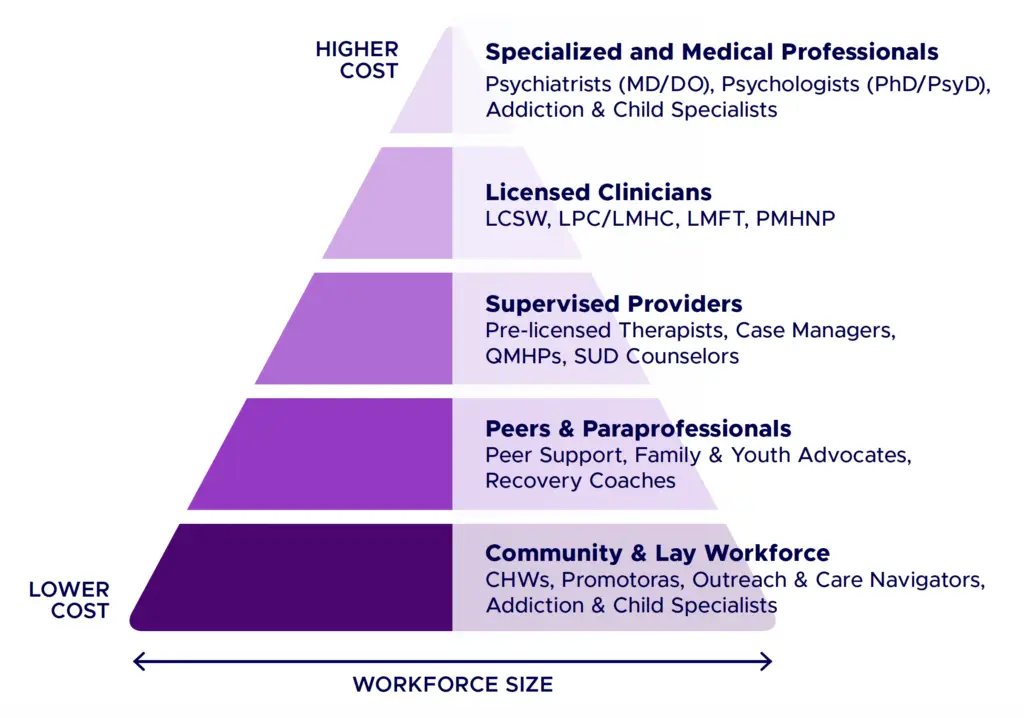
This pyramid illustrates how expanding the non-clinical workforce can help meet more people’s needs and reduce an overreliance on more costly, specialized services.

A Path Forward: Key Policy Priorities

States have meaningful tools to address these shortages. The following strategies, drawn from successful state examples across the country, offer a practical roadmap. They focus on attracting new professionals to the field, supporting and retaining those already serving, broadening the definition of who can deliver care, and leveraging technology to responsibly expand capacity.

1. Modernize Education and Training.

Creating an effective mental healthcare system means ensuring there are both enough providers and the right types of providers to meet demand. States can strengthen state workforce education centers, expand hands-on learning opportunities, and partner with higher education institutions to design and teach curricula that are aligned with the real-world needs of individuals with mental health and substance use challenges.

  • Establish a mental health workforce development center.
  • Develop accessible training and education programs on mental health, substance use, and suicide prevention for peers and paraprofessionals.
  • Offer paid internships and job-shadowing opportunities to youth to encourage early exploration and interest in the field.
  • Incentivize training curricula that ensures that healthcare professionals are better equipped to serve people with complex mental health conditions and substance use disorders.
  • Promote the use of psychiatric nurse prescribers by incentivizing training and education, easing supervision requirements, and allowing full practice authority.

2. Remove Financial Barriers to Entry.

A sustainable mental health system depends on a strong pipeline of providers entering the field. Yet for many prospective clinicians, the math simply doesn’t add up: high education costs, and unpaid clinical hours make the profession financially unattainable for many. Apprenticeships, loan repayment programs, and scholarships reduce financial barriers to entering the field. Reimbursing supervised pre-licensure care allows trainees to earn income while gaining clinical hours.

  • Expand the mental health provider pipeline through scholarship incentives and loan repayment programs.
  • Require health plans to reimburse supervised services by pre-licensure candidates.
  • Provide financial incentives for providers working in rural or high-needs environments.
  • Offer incentives for supervising and training interns and licensure candidates.
  • Develop apprenticeship models and “earn while you learn” pathways to licensure, particularly for certified peer support specialists and paraprofessionals.

3. Expand the Spectrum of Recognized Providers.

Licensed clinicians such as psychologists and psychiatrists play a critical role in the mental health workforce. But many people seeking support would benefit from a broader array of providers. Peer support specialists, behavioral health technicians, and other paraprofessionals can often effectively serve individuals with less complex needs — freeing licensed clinicians to focus on those requiring more specialized treatment. States can expand capacity by creating clear credentialing pathways, integrating these roles into Medicaid, and funding the supervision structures necessary to support them.

  • Create licensure pathways and credentialing programs for new mental health occupations, like crisis responders and behavioral health technicians.
  • Develop or expand community paramedicine programs that leverage EMS professionals to provide basic mental health evaluations and interventions and to refer people to specialized services as needed.
  • Encourage community-initiated care models that train non-clinicians to identify distress, offer support, build resilience, and connect people to care.
  • Incorporate mental health curricula into training programs for direct care workers, like certified nursing assistants and home health aides.
  • Revise restrictive scope-of-practice laws and regulations to allow providers to work at the top of their license.

4. Ensure Fair Reimbursement.

Requiring mental health services to be reimbursed at rates comparable to physical healthcare — using Medicare rates or another external benchmark — is among the highest-impact steps a state can take. Illinois recently set a rate floor to achieve fair reimbursement rates for in-network mental health and substance use disorder services, a model other states can follow.

  • Require mental healthcare to be paid comparably to physical healthcare, with Medicare rates or another external method as the benchmark.
  • Require Medicaid and commercial insurance coverage of certified peer support specialists and other paraprofessionals.
  • Conduct a study of Medicaid reimbursement rates for peer support specialists to evaluate and set rates that provide a “living wage.”

5. Promote Integrated Care.

The Collaborative Care Model — a team-based approach that includes a primary care provider, a behavioral healthcare manager, and a consulting psychiatrist — improves outcomes, reduces long-term costs, and makes more efficient use of limited workforce capacity. Nearly 40 states cover this model in Medicaid, but only 12 require commercial health plans to cover it, leaving a significant opportunity on the table. Allowing same-day billing for physical and mental health services removes another unnecessary barrier.

  • Cover the Collaborative Care Model of integrated mental health and primary care services in commercial insurance and Medicaid plans.
  • Fund start-up costs and technical assistance to promote adoption of the Collaborative Care Model in pediatric and adult settings.
  • Allow same-day billing for physical and mental health services under Medicaid.
  • Create licensure and payment models for new roles within integrated settings (e.g., navigators, community mental health aides).
  • Incentivize pediatricians and other primary care providers to receive training on mental health, substance use disorders, and suicide prevention.
  • Expand delivery of primary care services in community-based programs such as Certified Community Behavioral Health Clinics.

6. Streamline Licensure and Credentialing.

States can ease administrative and financial burdens on mental health professionals by simplifying and standardizing requirements, adopting interstate licensure compacts, and dedicating agency funding to reduce processing delays.

Forty-two states participate in the Psychology Interjurisdictional Compact; 39 in the Counseling Compact; 28 in the Social Work Licensure Compact, highlighting the value of alignment.

  • Join interstate licensure compacts, such as the Psychology Interjurisdictional Compact (PSYPACT), Counseling Compact, Social Work Licensure Compact, and School Psychologist Compact.
  • Modernize and streamline state licensing systems to reduce processing delays.
  • Fund state agencies to clear backlogs and shorten credentialing timeframes.
  • Establish a state position dedicated to overseeing training, certification, and supervision of peer and allied health workers.

7. Support Workplace Wellbeing.

Mental health providers are more likely to face burnout, increasing their likelihood of leaving the workforce. States can support measures that promote wellbeing among mental health providers to help them stay at work and thrive–from providing dedicated hotlines to revising discriminatory policies that deter providers from seeking care.

  • Fund mental health hotlines and other support systems for healthcare workers, including mental health providers.
  • Develop and fund incentives and training programs for organizations to become recovery-ready workplaces.
  • Revise policies that deter providers from seeking mental health and substance use disorder care.

8. Promote Data Collection and Reporting.

States need strong workforce data to identify shortage areas, align investments with need, and target solutions like loan repayment and training expansions. By facilitating data collection and partnering with educational institutions and industry stakeholders to put insights into action, states can better prepare the workforce of tomorrow.

  • Publicly report data on provider supply and distribution.
  • Require behavioral health licensing boards to collect and report data, including practice specialization, service setting and location, hours providing services, and types of services delivered.
  • Fund the creation of a real-time workforce data infrastructure to track provider supply, demand, wages, and distribution.
  • Create public-private partnerships with state universities and technology firms to research, analyze, and report on workforce gaps and opportunities.

9. Encourage the Use of Technology.

Technology offers significant potential to support the mental health workforce—if implemented thoughtfully and with appropriate safeguards. Maintaining telehealth flexibilities can expand access, while carefully regulated AI tools can reduce administrative burden, improve care coordination, and support evidence-based digital interventions.

  • Require commercial plans to cover telemental health services at in-person rates.

The Bottom Line

The mental health workforce challenge is serious, widespread, and — with the right policy choices — solvable. States that have taken targeted action are already seeing results. The Workforce Report provides state policymakers with concrete examples of what is working, a full state-by-state analysis of policy progress, and a menu of proven legislative and regulatory tools to close the gap.

Every person, regardless of where they live, what insurance they carry, or who they are, should be able to access mental healthcare when they need it. That future is within reach.

State Snapshots

Understand your state’s progress in adopting state policies that develop the pipeline of workers, bolster the existing workforce, and harness data and technology. For insights on these policy benchmarks, read this overview.

Resources

One-Pager

Integrating Mental Health Into Primary Care with Collaborative Care

One-Pager

Paying Mental Healthcare Comparably to Physical Healthcare

One-Pager

Loan Repayment, Scholarships, and Financial Incentives for Mental Health Workers

One-Pager

Expanding the Mental Health Workforce Through Interstate Licensure Compacts

One-Pager

State Mental Health Workforce Development Centers

One-Pager

Ensuring Telemental Health Parity

One-Pager

Reimbursement for Supervised Services

One-Pager

Strengthening the Mental Health Workforce Through Better Data

If you or someone you know needs help, call the 988 Suicide and Crisis Lifeline, which offers 24/7 judgment-free support for mental health, substance use, and more. Text, call or chat 988.